Ebook Free General Topology: Chapters 1–4 (Ettore Majorana International Science)
One to be reason of why you should pick this book can be acquired when you're starting. In addition, when finishing this publication, you can feel different life. What kind of distinction? It will additionally rely on your choice to alter your life. But, in fact this General Topology: Chapters 1–4 (Ettore Majorana International Science) come to be a few of one of the most desired publication on the planet. It provides you not only experience however likewise the brand-new knowledge.
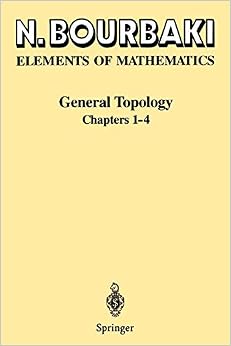
General Topology: Chapters 1–4 (Ettore Majorana International Science)

Ebook Free General Topology: Chapters 1–4 (Ettore Majorana International Science)
Now, exactly what do you consider the emerging publications this time around? So many books exist as well as released by numerous authors, from numerous countries in this world. But, have you to be more selective to pick one of the very best. If you are perplexed on exactly how you pick the book, you can extract from the subject to use, the author, and also the reference.
When you have actually made a decision to look for the new book title coming as the most recent book collection. Finding the title based upon the subject here is so very easy. You might not really feel so tough to discover it because we means make the lists of exactly what's brand-new in the site. Even this site offers you the connect to get the soft data of the book; we constantly provide you the very best that can ease to discover the book, as the General Topology: Chapters 1–4 (Ettore Majorana International Science) that we have advised.
Reviewing certainly this publication could produce the exact need and significant methods to undergo as well as overcome this trouble. Schedule as a window of the world could have the exact scenario of how this publication is presented. General Topology: Chapters 1–4 (Ettore Majorana International Science) as we recommend being candidate to review has some developments. Besides it is viewed from same subject as you require, it has likewise interesting title to review. You could likewise see exactly how the layout of the cover is stylised. They are really well done without disappointment.
Improving the life ability and also top quality will make you feel far better as well as to get it, it's at some point difficult. But, by analysis, it can be one of the wise methods to conquer it. That's' what always think to see just how specific publication as General Topology: Chapters 1–4 (Ettore Majorana International Science) could step forward making your life better. When you have different point to bear in mind or find out, you can locate other book title in this site, also.
Product details
Series: Ettore Majorana International Science (Book 18)
Paperback: 437 pages
Publisher: Springer; 1995 edition (September 18, 1998)
Language: English
ISBN-10: 3540642412
ISBN-13: 978-3540642411
Product Dimensions:
6.1 x 1 x 9.2 inches
Shipping Weight: 1.7 pounds (View shipping rates and policies)
Average Customer Review:
5.0 out of 5 stars
1 customer review
Amazon Best Sellers Rank:
#1,500,751 in Books (See Top 100 in Books)
this book is a bit denser than most other introductory general topology books. But it does quite exhaustive survey of important concepts pertaining to general topology.Since Bourbaki series builds upon its previous materials, many set theoretic ideas and terminologies are used without explanations. So unless one does have access to their previous book "Theory of Sets" there will be some minor frustrations/annoyances when reading this book.For the content, it starts with open set axioms for the topology like any other intro. topology text.Then Bourbaki shows how the neighborhood system determines a unique topology on a set and conversely. Next topic covered is continuity and the initial and final topology induced by a family of mappings and defines subset, product, and quotient topology in terms of the these two natural constructions. After covering these topics Bourbaki covers quotient various quotient mapping and some useful criteria for determining when the map from quotient space to the codomain after the canonical decomposition of a map becomes homeomorphism.Next topic covered is open and closed mapping along with equivalence relations being open or closed.After discussing general continuity without any major restrictions on the topological spaces, Bourbaki then introduces typical restrictions; namely compactness, Hausdorff, and regular conditions.Unlike many other major introductory topology books, Bourbaki does not talk about sequences nor nets in order to define compactness( quasi-compactness as Bourbaki calls it). Instead, he uses filters to define compactness. Using Zorn's lemma, existence of ultrafilter is shown and Tychnoff's theorem is proven using filter property in a very slick fashion.Also, there is a short section on germs, although this is not used in the rest of this book in any significant ways.Then, Bourbaki moves on to the topic of the limit and cluster(accumulation) point of a function of filtered space into a topological space and shows how the definition limit of a sequence or nets can be retrieved from a definition of limits of a function with respect to a filter.After covering this necessary tool or terminology, Bourbaki then covers Hausdorff space and regular space. Extension of a continuous function of a dense subset into a regular space, by continuity is shown in a very slick fashion. After covering this he does the typical stuff associated with compactness, paracompactness, and connectedness. These three sections are very similar to other intro. topology text in its content but with terminology adjusted for use of filter in these concepts.However, Bourbaki offers something you do not typically see in intro. topology text, in this section; proper mapping and inverse system.Proper mapping is shown as an alternative criterion for determining compactness, and other use of proper mappings are illustrated.Next section of this book is uniform space, which is a generalization of pseudo-metric spaces.Here, Bourbaki shows how a notion of completeness can be generalized to the setting of uniform spaces and introduces notion of Cauchy filter. The major result of this section is the construction of Hausdorff completion of a uniform space. This construction is essentially same as the construction of real numbers from Cauchy sequences of rational numbers but Bourbaki maintains the vocabulary of Cauchy filter. Also, instead of working with equivalent classes of Cauchy filters(or sequences if you prefer), Bourbaki uses a system of representatives called minimal Cauchy filters.Section 3 of this book, covers topological group. Using how a neighborhood systems determines a unique topology, he quickly determines criterion for existence of suitable topology such that this topology is compatible with the pre-existing algebraic structure; i.e. all the algebraic operations become continuous with this topology. Thus the completion stuff one might see in Lang's Algebra or in Atiyah's intro. commutative algebra will makes more sense after reading this section.Then the usual stuff of completion of topological group, ring, field, module is shown using tools developed in previous two sections. Also, using inverse system he does a few approximation stuff, which one can skip without disrupting further reading.Section 4 is the last section of this book, and Bourbaki finally talks about real number. Since he talked about completion of topological group, he defines real number as the Hausdorff completion of rational numbers considered as an additive topological group. After this consideration many results just fall out; such as rational line being dense in real, etc.After this characterization supreme property of a bounded set of real number is proved using Archimedes' Axiom(which is proved also). Then the usual criterion of compactness and connectedness in real line is proved. Here the proof of these facts are not given in the standard way deriving contradiction using supreme property. So it is interesting to see how the previous materials are used to prove these well know facts.Then monotone convergence of a function from directed set into a real number is discussed and its consequences are discussed;limsup, upper envelope of a family of continuous functions, etc. Also, upper and lower continuity is discussed and some familiar results are discussed in brief fashion.Finally, Bourbaki talks about series of real number and standard facts such as Cauchy's convergence criterion, alternating series test, etc are given along with n-ary expansion of real numbers.And this is where part 1 of this book ends.My overall impression is that this book(just like other Bourbaki book) is very user friendly, in that it does each proof very carefully. However, due to its constant build of a long logical chains, you really cannot read this book like a typical textbook; meaning you cannot skip around and the entire book must be read in a linear fashion.Also, the filter and uniform stuff is not typically covered in the introductory topology courses so to a novice this stuff might not be useful to your classwork(at least for the undergraduate or beginning graduate level). However, reading this book broadens your view on general topology for this book explains ideas behind the common concepts you encounter in other courses; such as use of filtration in a module to define a topology in an algebra course.Anyway, it seems to me that the biggest disadvantage of reading Bourbaki is its inefficiency. Meaning, stuff you really wanna see is not discussed unless you read through first 200 or 300 pages of this wonderful book. And this is probably the main reason why Bourbaki is not used as a standard text anymore;not because categorical language is not used as some might argue. So to a student with not enough studying time, this book will not useful when it is needed.
General Topology: Chapters 1–4 (Ettore Majorana International Science) PDF
General Topology: Chapters 1–4 (Ettore Majorana International Science) EPub
General Topology: Chapters 1–4 (Ettore Majorana International Science) Doc
General Topology: Chapters 1–4 (Ettore Majorana International Science) iBooks
General Topology: Chapters 1–4 (Ettore Majorana International Science) rtf
General Topology: Chapters 1–4 (Ettore Majorana International Science) Mobipocket
General Topology: Chapters 1–4 (Ettore Majorana International Science) Kindle


0 komentar:
Posting Komentar