Ebook Download China's Last Empire: The Great Qing (History of Imperial China), by William T. Rowe
As known, we are the best book website that constantly detail many points of publications from various nations. Of course, you could locate and appreciate browsing the title by search from the nation as well as various other countries on the planet. It indicates that you could consider many points while find the intriguing book to review. Related to the China's Last Empire: The Great Qing (History Of Imperial China), By William T. Rowe that we get rid of currently, we are not doubt anymore. Lots of people have actually shown it; show that this book provides good impacts for you.
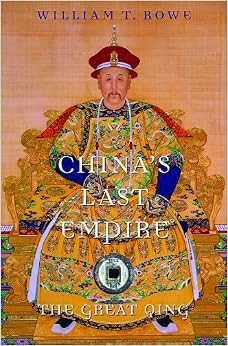
China's Last Empire: The Great Qing (History of Imperial China), by William T. Rowe

Ebook Download China's Last Empire: The Great Qing (History of Imperial China), by William T. Rowe
Locate your brand-new experience by reviewing China's Last Empire: The Great Qing (History Of Imperial China), By William T. Rowe, this publication will certainly offer you finished experience regarding this life. It might not always be by yourself to obtain such experiences if you have not yet the money. To intend the trips and activities, you can read this type of book. Yeah, this is a really incredible publication that will certainly provide several sort of experiences.
If you really wish to know the ways of getting this publication, you can follow to read this sales letter. In this instance, China's Last Empire: The Great Qing (History Of Imperial China), By William T. Rowe is among the products that we present. There are still lots of books from several countries, numerous writers with remarkable tiles. They are all provided in the web links for getting the soft documents of each publication. So it's so very easy to supply the remarkable functions of perfections.
When some individuals think that this is a hard publication to review, we will inform you that it turns into one of the smarter concepts to find with something different. The different points of the China's Last Empire: The Great Qing (History Of Imperial China), By William T. Rowe with other books are lasting en route how the writer improvise and pick the subject typically and surprisingly. It will be timeless and also countless to earn all people really feel embellished and also astonished of this book.
ever worry if this China's Last Empire: The Great Qing (History Of Imperial China), By William T. Rowe is not your favorite publication. We are here not just providing the only book. You can search the title in this web site as well as discover the hundreds collections of guides. You recognize, guides that we give are coming from all libraries as well as publisher on the planet. You might select title to title to gain guides to review. Yet previously, juts attempt to get this book due to the fact that it's very eye-catching. Attempt it as well as comment!
Review
In a fine, well-written study, Rowe brings the latest scholarship in Qing history to a wide audience. This book reflects a lifetime of reading in the field, and is written in the fluent manner of an accomplished and very successful author. Responsible and judicious, it makes an important contribution to our understanding of Chinese history. (R. Kent Guy, University of Washington)Here is a new narrative for Chinese history. It is based on the path-breaking scholarship of a small body of principally American scholars who have shown that after the non-Han Manchus conquered the Ming in 1644, traditional China was gradually replaced by something very different. This meant that the previous explanations, emanating from the Harvard school, led by the persuasive John King Fairbank, which emphasized a succession of essentially unchanging dynasties, must be abandoned...In short, as Professor Rowe sets out in this important book, "the inward-looking and hermetic Celestial Empire" has vanished and something far more interesting has come convincingly before us. (Jonathan Mirsky Times Literary Supplement 2009-12-04)A very fine book, drawing on the best new scholarship on this pivotal period in Chinese history. (K. E. Stapleton Choice 2010-03-01)This series on China, brilliantly overseen by Timothy Brook, is a credit to Harvard University Press. Above all, it encourages us to think of China in different ways. (Jonathan Mirsky Literary Review 2010-11-01)
Read more
About the Author
William T. Rowe is John and Diane Cooke Professor of Chinese History at Johns Hopkins University.
Read more
Product details
Series: History of Imperial China (Book 6)
Paperback: 368 pages
Publisher: Belknap Press: An Imprint of Harvard University Press; Reprint edition (September 10, 2012)
Language: English
ISBN-10: 0674066243
ISBN-13: 978-0674066243
Product Dimensions:
6.2 x 1 x 9.2 inches
Shipping Weight: 1 pounds (View shipping rates and policies)
Average Customer Review:
4.3 out of 5 stars
18 customer reviews
Amazon Best Sellers Rank:
#64,542 in Books (See Top 100 in Books)
This is sadly the last book in Harvard's 'History of Imperial China' series, edited by Timothy Brook. If only there were further dynasties following the Qing the saga could continue. Although the series featured several different authors, it has held together as a whole in style and content. Most of the previous features of the series are well represented in the present volume.William Rowe in large does a good job in just under 300 pages synopsizing the past and current historiography of the Qing. In the 20th century seen as a failed state, stagnant and insular, the Qing are re-envisioned as an expansionist multi-ethnic corporation from the viewpoint of our new millennium. Rowe takes us through the Ming overthrow narrative, the 'Golden Age', the Taiping Rebellion, and the imperialist and Republican challenges, almost 300 years in all.True to form, there are thematic chapters on the government and economy following the chronological material. Noticeably absent are the sections on religion, family, and literature that figured prominently in previous volumes. This is unfortunate as these parts transformed the series from standard textbooks​ into something more holistic.This last installment is nonetheless well written and up to date. If it does not quite measure up to the breadth of the prior books, it is still worth reading when you've come this far and don't otherwise know how the story ends. Incidentally, if you consider together all six volumes of roughly 350 pages each you have a combined work of over 2000 pages. This is not an inconsequential contribution to recent surveys available.
Note that there are more reviews on the Hardcover version's page.I came to this book having a decently thorough knowledge of Chinese history and having read the five "History of Imperial China" books leading up to it. I was not especially interested in the Qing, and this uniquely exciting treatment of the subject enabled me to understand why, and why I had been led to misunderstand this historical period. Rowe reviews the latest research, the research trends over decades since Wakeman changed things and Spence started his Qing journal in graduate school, while also showing how Western prejudices played their part in creating a hugely oversimplified stereotype: the stagnant Qing ruled by its inadequately modern rulers.In some ways I can measure a Chinese history book now by how many pages I can read without getting overwhelmed and needing to stop for the day in order to absorb what I have read. By that standard, this book has REALLY taken me a lot longer than I expected. The whole series has an amazing topical approach that each volume pursues with various merits, but in this, Rowe's volume, there is an intellectual excitement and a sense of the greater underlying story that I encourage anyone to allow themselves to engage with, with an open mind.China is vast and if you don't want to feel overwhelmed I cannot recommend reading any GOOD books about China. So much of the fun investigating China is the scope, the consistent framework, coming at familiar pieces of it all in unfamiliar ways, the regional and ethnic diversity and their endless implications, and of course the amazing efforts of Chinese civil servants who help Western readers like me NOT feel sorry for ourselves. Wow they had it hard.There is a 3D aspect to the Qing. It is richly documented. It includes interactions with the West and people who played a part in the 20th century. I can advocate this book as a panorama to anyone willing to have fun reading history. For anyone who wants to dig deeper, its footnotes and bibliography provide extensive guidance, explaining what one could gain from reading various Spence or Wakeman titles as well as dozens of other specimens of the academic literature. Page for page, it's a bargain and a good read.
Not many books deal with the rise and fall of the Qing Dynasty. A little light on pure history, and more oriented towards analysis. For instance, there is no deep dive into the reign of Cixi. If you "Look Inside the Book" at the Table-of-Contents, you will see that it is mostly broken down by different concepts, and only loosely unfolds chronologically. I've read through around a dozen big, mainstream books on Modern Chinese History, and this one has by far the best, and clearest overview of how the Manchus arose, and managed to take over the biggest country on EarthOn my first time through I found it tough to read at times. The author sometimes uses really long sentences where you have to stop mentally break them down to understand what they actually meanHOWEVER, there is a lot of good information in this book that I haven't found elsewhere, and unlike many books, I never have reason to doubt the truthfulness or intellectual-honesty of the text.I first read through this book about 3 months ago, but I am constantly browsing back through it all the time now, and I no longer find it difficult to read anymore.I strongly recommend this book for anyone interested in this time & place in history.
Once in a long time, comes a history that departs from the unpalatable choice of over-specialized/detailed research topic versus unoriginal/padded general overview. William Rowe's survey volume on the Qing Dynasty is happily one such volume. Rowe has not only thoroughly digested the ever-accumulating [and now fairly massive] specialized research on the period, but also fashioned a new conception of the dynasty that deserves the attention both general readers and specialists. As a past history major, I am usually quite cynical about those who talk of history as a "building block process" in which the specialists lay the bricks and the generalists make the buildings. But in this case, Rowe has built a fine structure that also does honor to those whose contributions he utilizes. This is now the finest general volume on the Qing and is not to be missed.
China's Last Empire: The Great Qing (History of Imperial China), by William T. Rowe PDF
China's Last Empire: The Great Qing (History of Imperial China), by William T. Rowe EPub
China's Last Empire: The Great Qing (History of Imperial China), by William T. Rowe Doc
China's Last Empire: The Great Qing (History of Imperial China), by William T. Rowe iBooks
China's Last Empire: The Great Qing (History of Imperial China), by William T. Rowe rtf
China's Last Empire: The Great Qing (History of Imperial China), by William T. Rowe Mobipocket
China's Last Empire: The Great Qing (History of Imperial China), by William T. Rowe Kindle


0 komentar:
Posting Komentar