Download PDF Debating Truth: The Barcelona Disputation of 1263, A Graphic History (Graphic History Series)
One of inspiring factors that you can opted to get this publication is because this is really appropriate to the problem that you deal with currently. The condition is not just for you that are not worried to get brand-new point, for you that constantly feel that you need new sources to make much better life. And also this book is very proper to check out even in just brief leisure time. Yeah, with the soft file of Debating Truth: The Barcelona Disputation Of 1263, A Graphic History (Graphic History Series), you could take easy to continually review as well as read this book once more.
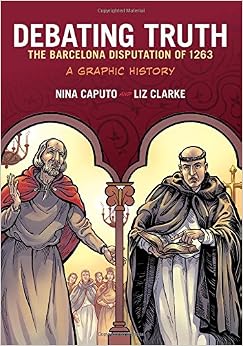
Debating Truth: The Barcelona Disputation of 1263, A Graphic History (Graphic History Series)

Download PDF Debating Truth: The Barcelona Disputation of 1263, A Graphic History (Graphic History Series)
There are several ideas that individuals supply to boost the life quality, concerning everything. Right here, we additionally will offer you a really easy tip to life better. Reading Debating Truth: The Barcelona Disputation Of 1263, A Graphic History (Graphic History Series) is our tip. Please ask why we suggest this book to read. Many individuals try to make themselves to be rich, however at some time they forget a very straightforward point. Checking out is really a basic point, yet lots of are lazy to do it. It's type of uninteresting activity and also waste the time.
By only connecting to the net as well as locate the link that we always give in every web page, you can follow up guide to obtain. They remain in the soft file programs. Now, we will certainly present you Debating Truth: The Barcelona Disputation Of 1263, A Graphic History (Graphic History Series) as a reading book today. We are actually sure that this book will be truly significant for you as well as people around you. As lots of people in other places, they have taken this publication as their analysis collection. So, we recommend to you to get also this book.
Today book Debating Truth: The Barcelona Disputation Of 1263, A Graphic History (Graphic History Series) we provide here is not kind of typical book. You know, reading currently does not mean to deal with the printed book Debating Truth: The Barcelona Disputation Of 1263, A Graphic History (Graphic History Series) in your hand. You could get the soft file of Debating Truth: The Barcelona Disputation Of 1263, A Graphic History (Graphic History Series) in your gadget. Well, we suggest that guide that we extend is the soft documents of guide Debating Truth: The Barcelona Disputation Of 1263, A Graphic History (Graphic History Series) The content and all points are same. The distinction is only the types of guide Debating Truth: The Barcelona Disputation Of 1263, A Graphic History (Graphic History Series), whereas, this condition will exactly pay.
Be different with other people that do not read this publication. By taking the great advantages of reviewing Debating Truth: The Barcelona Disputation Of 1263, A Graphic History (Graphic History Series), you can be smart to invest the moment for reviewing other books. And also right here, after getting the soft fie of Debating Truth: The Barcelona Disputation Of 1263, A Graphic History (Graphic History Series) and serving the link to provide, you can additionally locate other book collections. We are the most effective place to seek for your referred publication. As well as currently, your time to get this book as one of the compromises has been ready.
Review
"[T]hey have produced an outstanding, altogether original examination of this important event....A set of questions and resources for further research at the end enhance the book's value for undergraduates in classes on medieval Europe, Spain and the Mediterranean, Christian-Jewish relations, and seminars on historical methods. But it would also work well in a graduate seminar for the way it models historical thinking, and even scholars who know this material well--perhaps especially scholars who know this material well--will find the project highly illuminating."--Donald Copeland Klepper, The Historian"Nina Caputo's marvelous reconstruction of the Barcelona Disputation is much more than a traditional narrative history. It is a laboratory permitting her readers to sift and weigh the evidence for themselves. She presents the dossier of primary sources that past historians have drawn from and their range of conclusions; but even more valuably, she lets us into the historian's workspace, allowing us to use the tools that she and Liz Clarke have assembled for the occasion, inviting us to share in the uncertainties, lacunae, and forking paths of which real historical interpretation is made. Too often when reading history books we passively consume narrative information about the past. This book invites readers to participate actively in rethinking it."--Marina Rustow, Khedouri A. Zilkha Professor of Jewish Civilization in the Near East and Professor of History, Princeton University "It is a rare treat to encounter a work of such historical, and aesthetic, probity. Erudite, thoughtful, and imaginative, Nina Caputo has put together and created a new and searching range of documents with which to read and reconstruct the 1263 Barcelona Disputation--a major event in the old asymmetric conflict that opposed Christians to Jews and to Muslims. Debating Truth is an exemplary perspectival account of the characters and plots, the broad contexts and settings, and the meanings and aftermaths of this layered contest. Attentive to law, culture, religion, and politics--and to narrative and interpretation--Caputo and Clarke have produced a striking book, a visual and intellectual feat that demonstrates that there is indeed much to debate still about truth and representation."--Gil Anidjar, author of 'Our Place in al-Andalus': Kabbalah, Philosophy, Literature in Arab Jewish Letters "Debating Truth treats a timeless subject in a new way. How should believers in different faiths dispute the convictions that divide them? The Barcelona Disputation provides a famous medieval example of that question, now made available in a graphically novel and compelling way."--David Nirenberg, author of Neighboring Faiths: Christianity, Islam, and Judaism in the Middle Ages and Today "A visual delight and a narrative tour de force, Debating Truth uses the conventions of the graphic novel to unearth an authentic sense of the drama and danger that infused Christian-Jewish relations in the Middle Ages. In tandem with the source collection and Caputo's historical overview, it provides both an engaging and lucid introduction to medieval Spain and a chance for students and scholars alike to meditate on how we remember the past and how we tell our stories about it."--Jay Rubenstein, University of Tennessee "As a hybrid graphic history and academic work, Nina Caputo's Debating Truth not only offers an attractive and engaging book for classroom use but opens up welcome perspectives on the Barcelona Disputation. The graphic form forces the reader to contemplate the many gaps left in Nahmanides' account and in the historical record more generally."--Jonathan Decter, Brandeis University
Read more
About the Author
Nina Caputo is Associate Professor of History at the University of Florida. She is the author of Nahmanides in Medieval Catalonia: History, Community, Messianism (2007), and coeditor, with Andrea Sterk, of Faithful Narratives: Historians, Religion, and the Challenge of Objectivity (2014).Liz Clarke is a professional illustrator based in Cape Town, South Africa.
Read more
Product details
Series: Graphic History Series
Paperback: 256 pages
Publisher: Oxford University Press; 1 edition (July 15, 2016)
Language: English
ISBN-10: 0190226366
ISBN-13: 978-0190226367
Product Dimensions:
9.9 x 0.8 x 7 inches
Shipping Weight: 1.6 pounds (View shipping rates and policies)
Average Customer Review:
4.3 out of 5 stars
6 customer reviews
Amazon Best Sellers Rank:
#184,439 in Books (See Top 100 in Books)
This is my first time seeing a graphic history college text. The book's organization was most interesting -- a traditionally presented preface providing background history of the disputation, followed by 84 pages of the core of the book - a comic-book style serious history of the event based on the historical documents.Then English translations of the primary source documents, so readers can delve into the many issues.Than a more in-depth history of why medieval Aragon was different from the rest of Europe -- the blend of Christian, Muslim, and Jewish populations living in close proximity. Her views build on scholarship of recent decades, which is less rosy on how well that worked than late 19th to 20th century scholars. That is followed by a fascinating telling of how the presentation of the history of this event has shifted over the past 1-1/4 centuries.And finally, a discussion of graphic histories in general and their benefit in portraying events and personalities. Then the specifics on decisions in depicting the primary characters of this event and the scenes.All that is wonderful. The graphics do make clear an otherwise difficult set of readings. The history is solid.So why 3-stars and not 5 stars?1. The author discuses in that last section the difficulty in determining how to portray Nachmanides and Friar Paul (a convert) when no portraits exist. That should have been easy. It is well-known that Rembrandt used Spanish Jews exiled to Amsterdam as the subject of his biblical paintings. There's lots of them, easily available on a web search. The clothing would have changed, but not facial features over the ensuing 400 years. None of them look anything like the two ethnically Jewish characters in this book.2. There is discussion in that last section about portraying clothing and other personal features. Yet not a single mention of even a thought about head covering. Nachmanides, the most respected rabbi of Christian Spain at the time, is portrayed with no head covering in all interior scenes. That is beyond comprehension for any Jew before the 18th century. And especially a prominent rabbi talking about God and religious writings even today.3. The discussion minimizes the usefulness of medieval illuminated Spanish haggadahs for informing on clothing and appearance, in part because the illustrations might have been by Christian craftsmen. So what? They were hired by prominent Jews to make haggadahs for family use. The portrayals had to have been reasonably accurate, and most were produced in Catalonia only a few decades after the disputation.3. And a personal bias -- I prefer more traditional mid-20th century takes on the history of the Iberian convivencia among Muslims, Christians, and Jews over recent versions. The newer views seem a matter of professional opinion and emphasis on selecting facts than based on any new knowledge.
This may be a comic, but it also contains English translations of the original Hebrew and Latin texts of the Dispute - a new translation in the case of the Hebrew. The introductory material is also great. Real scholarship here, not just a comic. I did find it very odd, like another reviewer here, that Nahmanides is portrayed without at least a yarmulke! Very good. I recommend even more the wonderful film The Disputation - Nachmanides Debates Before King James of Aragon, though that is a bit looser in its interpretation of the story.
great book.. brings to life a piece of history vital to understand the Historic clash between Rabbinic Judaism, and Medieval Christianity. Many Jewish Rabbi's still consider this clash to be relevant to how they relate to the Modern Christian Church. very insightful.
Rabbi Moses ben Nachman (Nachmanides), was one of the greatest sages in Jewish history. When he was nearly 70 years old, he was placed in a difficult and somewhat untenable situation. Called to Barcelona, he had to defend his Jewish faith in a Catholic dominated country, summoned by a Catholic king who was raised by and had loyalty to Pope Innocent II. While he was given full reign to defend his faith, Nachmanides knew the reality was such that he could easily have won the battle, but lost the war. Which is precisely what occurred.Many English readers know of Nachmanides own account via the 1983 Charles Chavel translation of The disputation at Barcelona. In an interesting new book Debating Truth: The Barcelona Disputation of 1263, A Graphic History, author Nina Caputo (Associate Professor - Department of History at the University of Florida) has written not only an updated translation of Nachmanides account, but that of interlocutor also. More interestingly, the book provides a fascinating overview of the times and circumstances which lead to the disputation.As to A Graphic History, that refers to the first part of the book which uses about 70 pages of illustrations (superbly done by Liz Clarke) to provide a deeper narrative to the story. Caputo writes that while illustrations provide additional depth to the story, it comes with its own unique set of challenges; mainly as how the character is portrayed can change the nature of the story. One thing I noticed that amongst the many illustrations, Nahmanides is never pictured wearing a skullcap. That striking absence is not explained.The disputation of 1263 found Nahmanides summoned from his residence in Girona to Barcelona at the request of King James I of Aragon to debate with Paul, a Dominican Friar and lapsed Jew, regarding the Messiah in Judaism and Christianity. The debate was before a panel of judges lead by James. While James gave him liberty to speak as he wished, Nahmanides was understandably hindered by the concern of offending the Christians, and the serious repercussions that would bring.Caputo writes that disputations traces its roots as a philosophical form back to classic antiquity. Works by Plato and Aristotle use the dialogue form, as it is both pleasing and a compelling means of demonstrating the power and agility of a disciplined human intellect.As to the reason for the Barcelona disputation; members of the Dominican and Franciscan mendicant orders made extensive use of disputation in their campaigns to eradicate heresy. It’s not ironic then that these same mendicant orders accused Nachmanides of blasphemy when he later wrote his account.The book notes that while disputations were often intended as a missionary tool, they were an overall failure. Many who converted during those times did so not due to theological issues or that the disputation arguments persuaded them. Rather they converted due to the fact that circumstances of Jewish life had become untenable. That is similar to the thesis of Leaving the Jewish Fold: Conversion and Radical Assimilation in Modern Jewish History (Princeton University Press, ISBN 978-0691004792), by Todd Endelman.In translating Friar Paul’s account, Caputo astutely notes that while he and Nahmanides agreed on the overall notion of the disputation, the two narratives told opposite stories. Nachmanides account showed that he had won the debate and left with a cash gift from the king. While Paul’s account said that he was utterly defeated.Caputo also writes of scholars such as Heinrich Denifle who felt that Nachmanides account of the disputation was meant to mask the fact that he failed miserably in his task. Denifle also critiqued Heinrich Graetz in that he didn’t take into other sources, or accept Friar Paul’s interpretation of the Talmudic passages in question.It’s incredulous on the part of Denifle to think that Friar Paul’s poorly constructed Talmudic interpretations actually had merit. It’s fair to say that when summoned to Barcelona and authorized to speak freely, Nachmanides clearly knew that it was a Hobson's choice and even if he did fail miserably in his task as Denifle thought, it’s simply that it was not a level playing field.Denifle saw these disputations as similar to the Lincoln–Douglas debates. The reality is that it would be appropriate to switch James I to Kim Jong-un and Barcelona to Pyongyang, to understand the reality that Nachmanides faced.The milieu in which the disputations occurred shows the depth of the interfaith hostility that in the medieval Crown of Aragon. For the Jews, any disputation was an unwelcomed disruption that challenged the community’s sense of place and security. But Caputo notes that conversely, the fact that these disputations were able to take place, showed a very high level of social and cultural integration of Jews is a Christian society.Caputo has created a work that is intellectually fascinating and visually stimulating. By using the text of the disputations as the background, this is a most interesting book that details the events that lead to summoning Nachmanides to Barcelona, the disputation, and his ultimate exile from Aragon.
Debating Truth: The Barcelona Disputation of 1263, A Graphic History (Graphic History Series) PDF
Debating Truth: The Barcelona Disputation of 1263, A Graphic History (Graphic History Series) EPub
Debating Truth: The Barcelona Disputation of 1263, A Graphic History (Graphic History Series) Doc
Debating Truth: The Barcelona Disputation of 1263, A Graphic History (Graphic History Series) iBooks
Debating Truth: The Barcelona Disputation of 1263, A Graphic History (Graphic History Series) rtf
Debating Truth: The Barcelona Disputation of 1263, A Graphic History (Graphic History Series) Mobipocket
Debating Truth: The Barcelona Disputation of 1263, A Graphic History (Graphic History Series) Kindle


0 komentar:
Posting Komentar